
Let’s say your friend seems fine. They show up to work, make plans, and even crack jokes. But one day they tell you, “I just feel empty. Like nothing matters anymore.”
That feeling – persistent hopelessness or emotional numbness – is not something you can see. It’s an internal experience, not an outward behavior. And it’s a perfect example of a non-observable warning sign for a mental health condition.
These signs matter because mental illness rarely starts with flashing red lights. More often, it begins as a quiet, lonely struggle inside someone’s mind. In the United States, about 51 million adults are currently dealing with depression, and rates among young adults have more than doubled over the past decade. Yet many of these individuals keep up appearances while feeling overwhelmed inside.
Learning to recognize non-observable signs can help you support someone before they reach a crisis point.
Table of Contents
Key Takeaways
- others cannot directly see.
- Unlike observable signs – outbursts, neglecting hygiene, skipping work – these require listening and noticing subtle clues.
- Clues include language changes (“what’s the point”), quiet withdrawal, lingering exhaustion, over‑apologizing, and increased irritability.
- If you suspect someone is struggling, create a safe moment, listen without fixing, validate their feelings, and offer specific help.
- In a crisis or if suicidal thoughts are present, call or text 988 (U.S.) or 911 immediately.
-
A non-observable warning sign is an internal experience (like hopelessness or emotional numbness) that
Observable vs. Non-Observable: What’s the Difference?
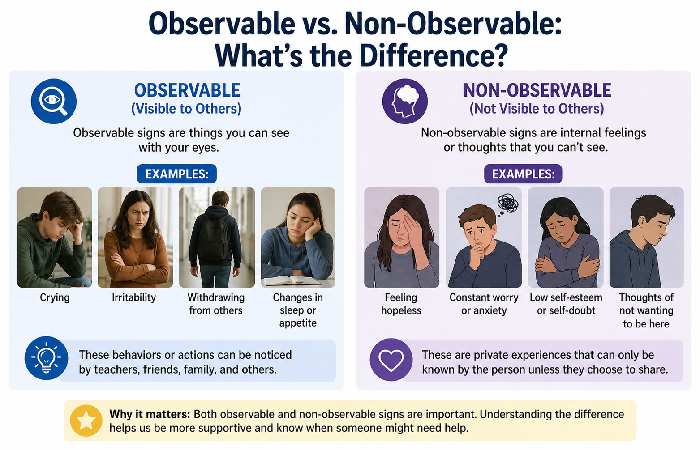
Understanding the difference is the first step.
| Observable Signs (Easy to See) | Non-Observable Signs (Hard to See) |
|---|---|
| Frequent angry outbursts in public | Persistent feelings of hopelessness |
| Noticeable decline in personal hygiene | Racing or intrusive thoughts |
| Visible withdrawal from friends | Emotional numbness or emptiness |
| Major changes in sleep or eating patterns | Chronic, unexplained fatigue |
| Skipping work or school repeatedly | Loss of ability to feel pleasure (anhedonia) |
Observable signs are actions or physical changes anyone can witness. Non-observable signs happen inside a person’s mind – they only become known if the person chooses to share them.
7 Clear Examples of Non-Observable Warning Signs
Here are the most common internal warning signs to watch for. Each is an example of something you can’t directly see but can learn to notice through careful attention.
1. Persistent Hopelessness
Someone may say, “What’s the point?” or “Things will never get better.” This isn’t just pessimism. It’s a deep belief that nothing will improve, often tied to depression or suicidal thoughts. The person may still go through daily motions, but inside they feel trapped.
2. Emotional Numbness or Emptiness
Not everyone with depression feels sad. Some describe feeling “blank,” “flat,” or disconnected”. Your loved one might say they can’t cry, can’t get excited, and can’t remember the last time they truly enjoyed something. This emotional shutdown is exhausting and often invisible.
3. Racing or Intrusive Thoughts
Anxiety doesn’t always look like panic attacks. Sometimes it sounds like a nonstop loop of worry: “Did I mess up that email?” “What if something bad happens?” Or worse, intrusive thoughts that feel terrifying and unwanted. You can’t see a racing mind, but you might notice the person seems distracted, on edge, or unable to focus.
4. Anhedonia – Loss of Pleasure
Anhedonia is the inability to feel joy in things that used to bring happiness. Picture someone who still goes to their favorite band’s concert but feels nothing. Or a person who continues their hobby out of habit while feeling empty inside. It’s like a light bulb slowly dimming rather than turning off suddenly.
5. Persistent, Unexplained Guilt or Worthlessness
“I’m a burden.” “Everyone would be better off without me.” These aren’t dramatic statements – they’re internal beliefs that can fester silently. A person might over-apologize for small mistakes or feel crushing guilt about things outside their control.
6. Chronic Fatigue That Rest Doesn’t Fix
Everyone gets tired. But this is different: an exhaustion that comes from the constant effort of hiding internal pain and pretending to be okay. Your loved one might sleep ten hours and still wake up drained. They may say, “I’m just tired,” but the tiredness never lifts.
7. Feeling Like a Burden
This is a particularly dangerous sign. When someone repeatedly says or implies they’re dragging others down, it can signal suicidal thinking. The person may isolate not because they want to, but because they genuinely believe their loved ones are better off without them.
How to Spot What You Can’t See: Subtle Clues That Matter
Because these signs are internal, you need to look for indirect clues. Here’s what to pay attention to in someone you care about:
-
Language changes. Listen for phrases like “what’s the point,” “I’m just tired of everything,” or self-deprecating jokes that feel heavier than usual.
-
Quiet withdrawal. They may still show up but seem less connected – shorter replies, avoiding deep conversations, drifting away slowly rather than dramatically.
-
Exhaustion that lingers. They complain of being drained even after rest, or struggle to get out of bed without a clear reason.
-
Over-apologizing or fear of making mistakes. Constant apologies for small things, or excessive worry about letting people down.
-
Increased irritability. Snapping over minor issues or becoming unusually defensive can be a sign of overwhelm, not “bad behavior”.
Remember: Someone can be struggling severely while still smiling, working, and meeting expectations. Looking “fine” doesn’t always mean feeling fine.
Common Myths vs. Facts
| Myth | Fact |
|---|---|
| “If they were struggling, I’d be able to tell.” | Many people mask their symptoms so well that even close friends and family don’t notice. |
| “They’re just being dramatic or lazy.” | Internal struggles like exhaustion anhedonia are real symptoms, not character flaws. |
| “Asking about suicide will plant the idea.” | Asking directly does not increase suicidal behavior. It can actually save a life. |
| “Only people who look sad are depressed.” | “Smiling depression” is real – someone can appear happy while experiencing severe symptoms internally. |
Who Should Use This Information – and Who Should Be Cautious
This guide is for: friends, family members, coworkers, teachers, coaches, and anyone who wants to better support the people in their life. You don’t need a medical background to notice changes in someone you care about.
Be cautious if: you’re in an emergency situation. Do not try to diagnose someone or force a conversation if they’re actively in crisis. If someone is at immediate risk of harming themselves or others, call 911 or take them to the nearest emergency room.
Also be cautious if: you have a personal history of trauma or mental health struggles. Supporting someone else can be emotionally heavy. Make sure you have your own support system in place first.
What to Do If You Suspect Someone Is Struggling (Step‑by‑Step)
If you’ve noticed some of the clues above, here’s how to respond in a helpful, non‑overwhelming way.
Step 1: Create a Safe, Private Moment
Find a quiet time when you won’t be interrupted. Avoid bringing things up in front of others or when either of you is rushed.
Step 2: Start with a Gentle, Open‑Ended Statement
“I’ve noticed you seem a bit off lately. I’m not here to judge – I just want to check in. How are you really doing?”
Step 3: Listen Without Trying to “Fix” Anything
Don’t jump in with advice or solutions. Just let them talk. Sometimes the most powerful thing you can say is, “That sounds really hard. I’m glad you told me.”
Step 4: Validate Their Feelings
Avoid phrases like “Just think positive” or “It’s not that bad.” Instead, try: “It makes sense you’d feel that way given what you’re going through.”
Step 5: Ask Directly About Safety (If Needed)
If you’re worried, ask plainly: “Have you had any thoughts about hurting yourself?” Asking does not make things worse – it shows you care.
Step 6: Offer Specific, Practical Help
Instead of “Let me know if you need anything,” try:
-
“Can I help you look up a therapist?”
-
“Would you like me to go with you to your first appointment?”
-
“How about I call and ask about their availability?”
Step 7: Encourage Professional Support
Suggest talking to a primary care doctor, a counselor, or calling a helpline. In the U.S., the 988 Suicide and Crisis Lifeline is free, confidential, and available 24/7 by call or text.
When to Act Urgently – And Exactly What to Do
If someone tells you they have a plan to harm themselves, or you believe they are in immediate danger:
| If the person… | You should… |
|---|---|
| Has a plan and means | Stay with them. Call 988 or 911. Remove access to any weapons or pills if safe to do so. |
| Is talking about suicide but has no current plan | Encourage them to call 988. Offer to stay on the line with them. |
| Has harmed themselves or is unconscious | Call 911 immediately. Do not leave them alone. |
Final Thoughts: You Don’t Have to Be a Professional
You don’t need a degree to notice when something feels off in someone you love. Spotting a non-observable warning sign isn’t about diagnosing a condition – it’s about paying attention, showing empathy, and creating a moment where someone feels safe enough to let you in.
One conversation won’t fix everything. But it can be the first step toward help, hope, and healing. And in the middle of a mental health crisis that affects tens of millions of Americans, that first step matters more than ever.
*If you or someone you care about is struggling, you are not alone. Call or text 988 (in the U.S.) to speak with a trained crisis counselor. It’s free, confidential, and available 24/7.*
Conclusion
Understanding what is an example of a non-observable warning sign for a mental health condition in someone else gives you a powerful tool: the ability to notice what others miss. The quiet struggles – hopelessness, numbness, racing thoughts, exhaustion that won’t lift – are just as real as the visible ones. By learning to spot them and knowing how to respond, you can be the person who reaches out before a small struggle becomes a full crisis. That’s not just good friendship. It’s lifesaving.
FAQs
What is an example of a non-observable warning sign for a mental health condition in someone else?
Persistent feelings of hopelessness or worthlessness reported by the individual are classic examples. These are internal emotional states that cannot be directly observed by others.
What’s the difference between observable and non-observable warning signs?
Observable signs can be directly seen – like angry outbursts, poor hygiene, or skipping work. Non-observable signs are internal experiences that only the person can describe, such as emotional numbness, intrusive thoughts, or feeling like a burden.
How can I tell if someone is struggling if they seem fine?
Look for quiet clues: language changes (“what’s the point”), shorter replies, lingering exhaustion, over‑apologizing, or increased irritability. Many people mask their struggles while appearing fully functional.
What should I do if I think a friend might be suicidal?
Stay with them. Ask directly: “Are you thinking about killing yourself?” Remove access to any means if safe. Call or text 988 (U.S. Suicide & Crisis Lifeline) or 911 if there’s immediate danger. Asking does not increase risk – it saves lives.