
Most companies spend heavily on recruitment bonuses, referral programs, and higher salaries to keep people from quitting. But they often overlook one of the most powerful retention levers: a well-implemented safety and health program.
This isn’t just about avoiding OSHA fines or posting “Safety First” posters. It’s about building a workplace where employees genuinely feel safe, valued, and supported. When done right, a strong safety and health program becomes a competitive advantage that reduces turnover, attracts better talent, and saves millions in hiring costs.
Let’s break down exactly how a well-implemented safety and health program affects employee retention — backed by 2026 data, real-world research, and practical steps you can use today.
Table of Contents
Key Takeaways
- A well-implemented safety and health program reduces turnover by building trust, reducing stress, and demonstrating genuine care for employees.
- 78% of workers would consider leaving a job due to unsafe conditions — safety is a retention issue, not just a compliance issue.
- Strong safety cultures are linked to a 24% to 59% lower turnover rate compared to weak safety cultures.
- Every 1investedinworkplacesafetyreturns1investedinworkplacesafetyreturns4 to $6 in savings, including lower turnover and hiring costs.
- Key components: visible leadership, employee involvement, mental health support, return-to-work programs, and continuous improvement.
How Does a Well-Implemented Safety and Health Program Affect Employee Retention?
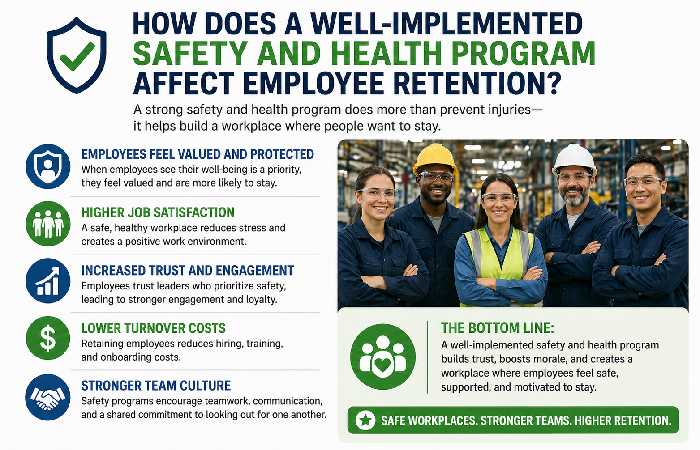
A well-implemented safety and health program affects employee retention by creating a secure work environment where employees feel physically protected, psychologically supported, and genuinely valued by leadership. This combination of physical and psychological safety builds trust, reduces stress, and increases job satisfaction — all of which are proven drivers of employee loyalty and lower voluntary turnover.
By the Numbers: Hard Evidence That Safety Programs Retain Talent
Let’s start with the data, because the numbers tell a clear story.
| Key Finding | Data Point | Source |
|---|---|---|
| Workers would leave due to unsafe conditions | 78% would consider leaving a position | EcoOnline 2026 Report (U.S./Canada) |
| Safety affects job choice | 77% say safety affects employer choice | EcoOnline 2026 Report |
| Lower turnover in strong safety cultures | 24% to 59% lower turnover rates | Workplace safety research |
| Employees stay for mental health support | 79% likely to stay with quality mental health resources | Modern Health research |
| Workplace safety explains retention variation | Up to 67% of retention variation | Wellhub data |
That last number is worth pausing over: workplace safety alone explains roughly 67% of the variation in employee retention — meaning how safe people feel has a massive influence on whether they stay or go.
“Employees who feel physically and mentally safe at work develop stronger connections to their employers.” — APHLnet analysis
8 Specific Ways a Safety and Health Program Improves Retention
Now let’s move from statistics to mechanisms — the actual “how.”
1. Builds Trust and Demonstrates Real Employer Commitment
When leadership visibly invests in safety — proper training, quality equipment, adequate staffing, listening to concerns — employees interpret that as a clear signal: “This company cares about me, not just my output.” That trust directly reduces the desire to look for other jobs.
Why it matters: Trust is the foundation of the employer-employee relationship. Without it, even a high salary won’t keep people around.
2. Reduces Workplace Injuries and Absenteeism
Fewer injuries mean fewer lost workdays, lower stress about getting hurt, and less time spent recovering. OSHA’s Voluntary Protection Programs (VPP) sites have injury rates about 52% below industry averages. Employees who stay healthy and uninjured are far more likely to stay long-term.
3. Lowers Stress and Prevents Burnout
Unsafe or poorly managed work environments create chronic anxiety. Clear safety procedures reduce daily worry. And when safety programs include mental health resources — stress management, Employee Assistance Programs (EAPs), counseling access — employees feel equipped to handle challenges without burning out and quitting.
4. Creates a Positive Workplace Culture
Safety programs that include employee participation — safety committees, near-miss reporting, stop-work authority — increase employee voice and engagement. These are the exact factors that predict retention. A strong safety culture promotes teamwork, mutual accountability, and shared purpose.
5. Supports Mental Health and the “Whole Person”
Modern safety programs go far beyond hard hats. They address physical safety and mental wellbeing through stress risk assessments, mental health first aiders, and access to EAPs. Employees who feel supported mentally and emotionally are far more likely to stay, especially during difficult periods.
6. Strengthens Employer Brand and Attracts Better Hires
A reputation for safety excellence helps you attract better candidates — and better hires tend to stay longer. Nearly three-quarters of employees (73%) say they want to know about a company’s health and safety program before accepting a job offer. When safety is a recruiting advantage, retention starts before day one.
7. Lowers Absenteeism and Improves Productivity
Fewer injuries and health problems mean fewer lost workdays and less “presenteeism” (working while unwell). Prevention programs can dramatically reduce lost-time events. Productive, healthy employees are engaged employees — and engaged employees don’t quit.
8. Delivers Financial ROI That Reinforces Retention Efforts
Safety programs aren’t just good for people; they’re good for business. Every 1investedinaneffectiveworkplacesafetyprogramreturns1investedinaneffectiveworkplacesafetyprogramreturns4 to $6 in savings through lower healthcare costs, fewer injuries, reduced absenteeism, and stronger productivity. Those savings can be reinvested into more retention initiatives, creating a virtuous cycle.
Who This Is For (And Who Should Be Cautious)
This guide is for: business owners, HR leaders, safety managers, operations directors, and anyone responsible for employee retention in the United States — especially in higher-risk industries like construction, manufacturing, healthcare, transportation, and warehousing.
Be cautious if: you’re currently in crisis mode with immediate safety violations. Address those first. Also, this is not a substitute for legal compliance with OSHA standards. Always consult qualified safety professionals for site-specific needs.
Common Mistakes That Undermine Retention Benefits (And How to Avoid Them)
| Mistake | Why It Hurts Retention | Better Approach |
|---|---|---|
| Treating safety as a compliance checkbox | Employees see it as performative, not genuine | Build a living culture, not a paper program |
| No employee involvement | Workers feel unheard and disrespected | Create safety committees and anonymous reporting |
| Ignoring mental health | Physical safety alone isn’t enough | Integrate stress management and EAPs |
| One-size-fits-all training | Boring, forgettable, and ineffective | Job-specific, interactive, ongoing training |
| No return-to-work support | Injured employees feel abandoned | Implement structured light-duty programs |
What “Well-Implemented” Actually Looks Like: Practical Components
A retention-boosting safety and health program includes:
-
Active leadership commitment — visible, resourced, and measured, not just announced
-
Comprehensive hazard identification — not just incident response, but proactive risk control
-
Regular, practical training — job-specific, with competency assessments
-
Genuine employee involvement — safety teams, near-miss reporting, suggestion channels
-
Return-to-work and light-duty programs — supporting injured workers to come back
-
Ergonomics and preventive health — reducing chronic injury risk
-
Mental health integration — EAPs, stress resources, work-life balance
Myths vs. Facts: What Safety Programs Actually Do for Retention
| Myth | Fact |
|---|---|
| “Safety programs are just a cost center.” | Every 1investedreturns1investedreturns4–$6 in savings, including lower turnover costs. |
| “Employees only care about pay.” | 78% would consider leaving due to unsafe conditions — pay isn’t everything. |
| “Compliance is enough.” | Compliance prevents fines, but culture prevents turnover. Most employees want more than minimum standards. |
| “Safety is just about physical hazards.” | Modern safety includes mental health. 79% are more likely to stay with quality mental health support. |
Step-by-Step: How to Build a Safety Program That Actually Improves Retention
-
Conduct a needs assessment — Survey employees about safety concerns and mental health needs.
-
Secure visible leadership commitment — Allocate budget, time, and resources. Lead by example.
-
Create an employee-led safety committee — Give workers real authority to identify and fix hazards.
-
Integrate mental health support — Add EAPs, stress management resources, and work-life balance policies.
-
Implement return-to-work programs — Structured light-duty options for injured employees.
-
Measure and communicate — Track incident rates, turnover, engagement, and absenteeism. Share progress openly.
-
Continuously improve — Use data to adjust and expand what works.
Conclusion
How does a well-implemented safety and health program affect employee retention? The evidence is overwhelming: it directly reduces turnover by building trust, lowering stress, preventing burnout, and showing employees they truly matter.
In today’s tight labor market, where 78% of workers would consider leaving due to unsafe conditions, ignoring safety as a retention strategy is a costly mistake. The companies that treat safety as a genuine investment in their people — not just a legal requirement — will win the talent war. They’ll keep their best employees longer, spend less on hiring and training, and build a reputation that attracts top talent.
Start with one change this week: ask your employees what would make them feel safer. Then listen. And act. That’s where retention begins.
FAQs
How does a well-implemented safety and health program affect employee retention?
A well-implemented safety and health program increases retention by building trust, reducing workplace injuries, lowering stress and burnout, supporting mental health, and demonstrating that leadership genuinely values employee wellbeing. These factors directly lower voluntary turnover.
What percentage of workers would leave a job due to unsafe conditions?
According to a 2026 EcoOnline survey of 1,200 U.S. and Canadian workers, 78% said they would consider leaving a position due to unsafe working conditions.
What is the ROI of a workplace safety program?
Every 1investedinaneffectiveworkplacesafetyprogramreturns1investedinaneffectiveworkplacesafetyprogramreturns4 to $6 in savings through lower healthcare costs, fewer injuries, reduced absenteeism, and stronger productivity.
What are the key components of a retention-focused safety program?
Active leadership commitment, employee involvement, regular practical training, hazard identification systems, mental health support (EAPs, stress management), return-to-work programs, and continuous improvement processes.
Where can I find official OSHA guidelines for safety programs?
The U.S. Occupational Safety and Health Administration (OSHA) provides comprehensive guidelines at www.osha.gov.
Wikipedia Reference Link